Why replacing an Executive Chef cannot repair an operation that refuses to change
There is a familiar pattern in the hospitality industry. A restaurant, hotel, resort or hospitality group begins to struggle operationally. Food costs are higher than expected, consistency deteriorates, staff turnover increases, purchasing becomes problematic, communication between departments weakens, guest complaints appear, and the kitchen seems permanently under pressure. Management begins searching for the source of the problem and, because the Executive Chef is one of the most visible people responsible for the final product, attention quickly turns toward the kitchen.
The Executive Chef is replaced. A new professional arrives carrying a new résumé, a different philosophy, fresh ideas and, inevitably, a new set of expectations. Menus are reviewed, recipes are changed, suppliers are questioned, the brigade is reorganized and standards are discussed again. For a period, the business experiences what might be called the “new Chef effect”: there is energy, movement and optimism. Management believes a new chapter has begun.
Then, gradually, something uncomfortable happens. The same problems begin to return.
Food costs remain difficult to control. Staffing remains unstable. Quality fluctuates. Purchasing continues to create complications. Communication breaks down again. The relationship between the kitchen and other departments remains strained. The new Chef begins fighting many of the same battles as the previous Chef. Eventually, frustration grows, confidence disappears and another change of leadership takes place.
A third Executive Chef arrives. Perhaps a fourth.
At some point, a serious business must stop asking only, “Is the Chef the problem?” and begin asking a considerably more difficult question:
“Why do the same problems keep surviving every Chef?”
That question changes the entire discussion, because repeated failure under different leaders may no longer be evidence of repeated individual failure. It may be evidence of a system that continually reproduces the same result.

The Executive Chef Is Responsible — but Not Omnipotent
An Executive Chef carries enormous responsibility. Depending on the operation, that responsibility may include food quality, menu development, production, hygiene, food safety, staffing, training, discipline, scheduling, purchasing, inventory, waste, labor costs, food costs and a substantial part of the guest experience. In modern hospitality, the position has also become increasingly commercial. The Chef is expected not only to cook and lead but to understand margins, productivity, recruitment, branding, sustainability, supplier relationships and the financial consequences of culinary decisions.
These expectations are reasonable when the Executive Chef has an operating environment that makes them achievable.
The problem begins when responsibility and authority become disconnected.
Consider something as fundamental as food cost. Management may tell the Executive Chef that the percentage is too high and must be reduced. That appears perfectly reasonable. But does the Chef control purchasing? Can suppliers be changed when their prices or quality become unacceptable? Can products that fail specification be rejected? Can recipes and portions be modified? Can commercially unsustainable dishes be removed? Can menu prices be adjusted when ingredient costs increase significantly? Can purchasing decisions made by another department be challenged?
If the Chef is responsible for the number but cannot meaningfully control the variables producing that number, the business has created responsibility without sufficient authority.
A Title Does Not Automatically Create Authority
The same contradiction appears with labor. Management may demand that the Chef reduce payroll while simultaneously insisting on long opening hours, an extensive menu, elaborate preparation, multiple outlets or services, and uncompromising quality. The Chef may be told to “fix the team” while having limited influence over recruitment, salaries, contracts, dismissal, staffing levels or working conditions. Again, the result is predictable: the individual is held accountable for an outcome without controlling many of the conditions required to produce it.
This is not effective management. It is accountability without control.
One of the most damaging organizational problems in hospitality is unclear authority. An individual can carry the title of Executive Chef and still have surprisingly little executive control over the kitchen.
The organizational chart may say that the Chef runs the department, while operational reality says something completely different. The General Manager interferes with staffing. The owner changes dishes. Purchasing chooses suppliers. Finance refuses essential expenditure. The F&B department makes decisions affecting service without consulting the kitchen. Corporate management imposes products or procedures that do not suit the operation. Employees bypass the Chef and appeal directly to someone higher in the hierarchy whenever they dislike a decision.
Each intervention may appear minor when viewed individually. Collectively, however, they can dismantle the authority of the position.
A brigade quickly understands where real power exists. If employees discover that the Executive Chef’s decisions can routinely be overturned, ignored or negotiated elsewhere, authority becomes symbolic. Discipline becomes increasingly difficult because instructions are no longer final. Standards become negotiable because employees understand that another manager may provide a different answer. Eventually the Executive Chef remains responsible for the performance of a team that has learned that the Chef is not fully empowered to manage it.
Replacing that Chef does not solve the structural contradiction. The next person simply inherits it.
A professional operation therefore needs more than impressive job titles. It needs clearly defined areas of responsibility, equally clear decision-making authority and an understood chain of command. Without those elements, management should not be surprised when departmental leadership becomes ineffective.

The Brigade Beneath the Chef Matters as Much as the Chef
Another recurring mistake is assuming that changing the person at the top will compensate for weaknesses throughout the rest of the kitchen.
A restaurant cannot demand one level of performance while staffing another.
Fine dining, luxury hospitality, high-volume restaurants, banqueting operations and complex hotel kitchens all require different organizational structures, but they share one fundamental requirement: the Executive Chef needs capable people underneath them. A strong kitchen depends on competent sous chefs, reliable section leaders, appropriately trained cooks, pastry support where necessary, stewarding and enough personnel to execute the concept consistently.
Headcount alone means very little. Ten employees do not necessarily constitute a functional brigade if the skill distribution is wrong. A kitchen can simultaneously appear heavily staffed on a spreadsheet and remain operationally weak because too few employees can independently run a section, supervise production, maintain standards or train others.
When the structure beneath the Executive Chef is inadequate, the Chef gradually stops performing the role for which they were hired. Instead of developing the operation, training senior staff, analyzing costs, improving systems and protecting standards, the Chef spends every day filling gaps. Someone calls sick, so the Chef covers a station. A section cannot execute properly, so the Chef takes over. Purchasing fails to deliver something essential, so the Chef searches for alternatives. Equipment breaks, so production must be reorganized. An employee resigns, so the remaining brigade absorbs the workload.
Exceptional leaders can compensate for structural weakness for a period of time. They cannot do it indefinitely.
A Chef permanently functioning as emergency labor is not leading a healthy operation. The fact that the Chef can keep the kitchen alive despite those conditions should not be confused with evidence that the conditions are acceptable.

Purchasing Problems Eventually Become Kitchen Problems
Purchasing is one of the least glamorous subjects in hospitality, yet it has an extraordinary influence over culinary performance. Every plate served to a guest begins with procurement long before it reaches a cutting board, pan or pass.
If purchasing is unreliable, the kitchen becomes reactive. A Chef develops a dish around a particular product specification, but a cheaper substitute arrives. A supplier capable of delivering consistent quality is replaced because another offers a marginally lower price. Quantities arrive incorrectly. Deliveries are late. Products are substituted without consultation. Seasonal availability is ignored during menu planning. Storage limitations prevent efficient purchasing. Ingredient prices change without corresponding adjustments to menu pricing.
Every one of these decisions creates consequences inside the kitchen.
Different products produce different yields. Different yields alter recipe costs. Substitutions affect preparation methods. Inconsistent quality creates inconsistent cooking. Poor specifications increase trimming and waste. Late deliveries disrupt mise en place. Emergency purchasing increases cost. Eventually the kitchen begins changing recipes simply to survive the instability of the supply chain.
The guest, of course, sees none of this. The guest sees the plate. Senior management may also see only the plate. Because the Executive Chef’s name is associated with that plate, the Chef becomes the natural person to question when consistency declines.
But operational analysis must travel backwards through the process. Sometimes the problem visible at the pass began days earlier in purchasing, procurement, storage, maintenance or administration.

When the Concept and the Operation Live in Different Worlds
Some restaurants suffer from an even deeper problem: the concept management wants to sell is incompatible with the operation management is prepared to support.
Almost every hospitality business wants excellence. The difficulty is that excellence is not an adjective that can simply be inserted into a marketing presentation. Excellence has an operating cost.
A sophisticated culinary concept requires skilled labour, excellent products, reliable suppliers, appropriate equipment, adequate refrigeration and storage, disciplined systems, substantial training and enough preparation time to execute the food consistently. The more ambitious the culinary promise becomes, the more important this infrastructure becomes.
A business cannot realistically demand Michelin-level execution while financing cafeteria-level resources. It cannot build a labor-intensive menu and simultaneously reduce the brigade below the level necessary to produce it. It cannot advertise handmade production while allocating industrial production time. It cannot position itself as luxury while instructing purchasing to select products almost exclusively according to the lowest price. It cannot continually increase complexity while reducing the resources available to manage that complexity.
Eventually, operational mathematics defeats aspiration.
This is where an Executive Chef can become trapped between brand ambition and financial reality. Management wants the appearance of a sophisticated restaurant but is unwilling or unable to support the machinery required behind that appearance. The Chef is then expected to bridge the gap through personal effort, creativity and sacrifice.
For a while, an exceptional professional may manage it.
Eventually, the contradiction wins.
And when the Chef leaves, the business hires another person to attempt exactly the same impossible equation.b
The False Comfort of the “New Chef Effect”
Replacing a senior employee feels decisive. It produces immediate and visible change, which is one reason organizations are often attracted to it.
A new Executive Chef arrives and activity increases. Menus change. Recipes are rewritten. Storage areas are reorganized. New dishes appear. Suppliers receive calls. Meetings are held. Employees are retrained. There is a sense of movement throughout the operation.
Movement, however, should never be confused with structural improvement.
If the underlying operating conditions remain untouched, the new Chef eventually encounters the same walls. The purchasing restrictions remain. The staffing limitations remain. The broken equipment remains. The unclear authority remains. The unrealistic budget remains. The dysfunctional relationship between departments remains. The conflict between the culinary concept and available resources remains.
The honeymoon ends because the new person has reached the same structural limitations as the previous person.
Management then faces an important choice. It can investigate those limitations, or it can conclude once again that the Chef was not good enough.
The second option is easier.
It is also how the cycle continues.
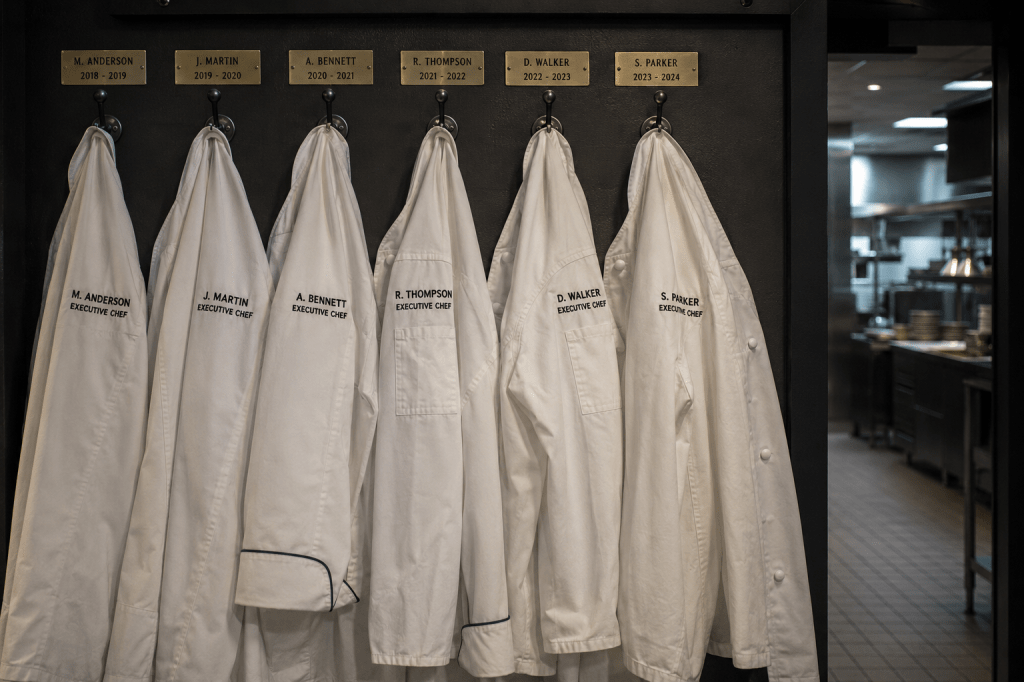
Executive Chef Turnover Eventually Becomes Part of the Problem
Repeatedly changing Executive Chefs does not merely fail to solve systemic problems. After enough repetitions, the turnover itself becomes an operational problem.
Every Executive Chef introduces a different philosophy, management style, menu structure, production system, supplier preference and interpretation of standards. Every transition requires the brigade to adapt. Recipes change, responsibilities move, new procedures are introduced and old habits are challenged.
Occasional leadership change is normal and sometimes healthy. Constant leadership change produces a very different psychological effect.
Employees begin to wait.
They have already seen the new Chef arrive with enthusiasm. They have already attended the meetings about the new direction. They have already learned new recipes, accepted new systems and heard promises that “things will be different now.”
After the third or fourth cycle, experienced employees may conclude that there is little reason to invest deeply in another transformation. They know that if they wait long enough, the Chef may leave and another system will replace the current one.
This is extremely dangerous because institutional authority begins to reverse. Permanent employees become more culturally powerful than temporary leaders. Resistance becomes a survival strategy. New standards are treated as temporary preferences rather than organizational expectations.
The business has then created precisely the environment it expects the next Executive Chef to repair.

Sometimes the Chef Really Is the Problem
None of this removes responsibility from Executive Chefs.
Some Chefs fail because they are simply unsuitable for the position. Technical talent does not automatically create leadership ability. A brilliant cook may be incapable of managing people. Another may understand cuisine but not finance. Some cannot communicate. Some create destructive working environments. Some cannot delegate. Some refuse to adapt to commercial realities. Others may lack the discipline, administrative competence or emotional maturity required to lead a complex operation.
Those situations exist, and businesses should deal with them.
Replacing an Executive Chef can be entirely justified.
The important distinction is between individual failure and systemic failure.
One Chef encountering serious problems may indicate an individual problem. Two Chefs encountering remarkably similar problems should provoke investigation. When three or four competent professionals pass through the same position and repeatedly encounter the same difficulties, management should stop treating each departure as an unrelated event.
Patterns are operational evidence.
A problem that existed before a Chef arrived, continued throughout that Chef’s tenure and remained after the Chef departed deserves investigation beyond the person occupying the position.
Before Hiring the Next Executive Chef
Before another vacancy is published and another candidate is promised an exciting opportunity to “transform the culinary operation,” management should conduct an honest operational audit.
The investigation should begin with the objectives given to the previous Executive Chef. Were they clearly defined? Were they financially realistic? Did the Chef possess the authority necessary to achieve them? Were staffing levels appropriate for the concept and operating hours? Was the brigade sufficiently skilled? Could underperforming employees actually be replaced? Were purchasing systems reliable? Were product specifications respected? Was equipment adequate and properly maintained? Was the menu compatible with the physical kitchen, available labour and expected volume? Did management consistently support the standards it expected the Chef to enforce?
Management should also examine its own behaviour. Were decisions made through a clear chain of command or through politics and personal relationships? Was the Chef genuinely empowered to manage the department, or was every significant decision subject to interference from several directions? Were problems investigated objectively, or was the Executive Chef simply the most convenient person to hold responsible?
Most importantly, the business should identify which operational problems existed before the Chef arrived and determine whether those same problems remained after the Chef left.
That exercise can reveal more about an organization than another recruitment process ever will.
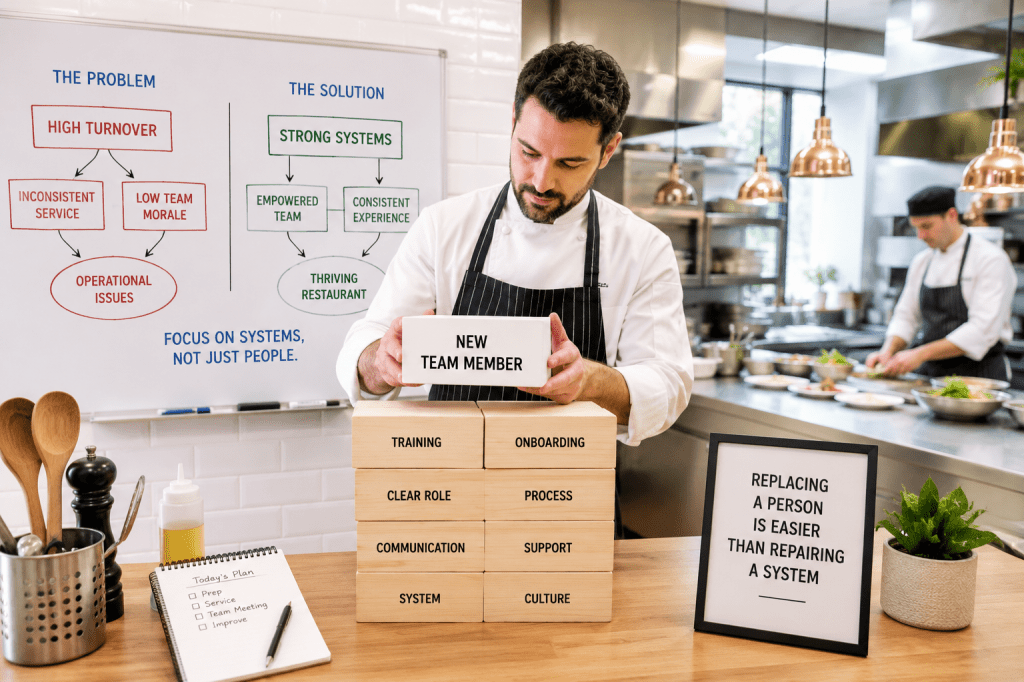
Replacing a Person Is Easier Than Repairing a System
There is a simple reason businesses sometimes replace people instead of systems.
Replacing a person creates the appearance of immediate action.
Someone leaves. Someone new arrives. There is a new biography, perhaps a new photograph, a redesigned menu and an announcement about a new culinary direction. The organization can point toward something tangible and say that the problem has been addressed.
Repairing a system is much less theatrical.
It may require reviewing purchasing contracts, restructuring management responsibilities, changing recruitment practices, increasing salaries, investing in equipment, reducing opening hours, simplifying menus, improving communication between departments or reconsidering financial expectations.
It may also require something considerably more difficult: management acknowledging that some of its own decisions contributed to the failure.
Systemic improvement rarely provides the emotional satisfaction of replacing somebody. It requires patience, analysis and often investment. It can expose historical mistakes and challenge internal politics.
But sustainable hospitality businesses are built through coherent systems, not repeated personnel resets.

Accountability Must Work in Both Directions
An Executive Chef should absolutely be accountable for the kitchen. Senior leadership without accountability is not leadership.
But accountability must be attached to authority and resources.
If the Chef accepts responsibility for food cost, the Chef needs meaningful influence over the purchasing and menu decisions that determine food cost. If the Chef is responsible for the brigade, the Chef needs genuine authority to structure, recruit, develop and discipline that brigade. If management demands a particular standard of cuisine, the organization must provide products, equipment, staffing and preparation conditions capable of producing that standard.
This does not mean giving Executive Chefs unlimited authority. No responsible business operates that way. It means constructing an operating model in which responsibility, authority and resources are reasonably aligned.
When they are aligned, accountability is legitimate.
When they are deliberately separated, accountability becomes convenient.
The Question Management Should Eventually Ask
There comes a point when repeated Executive Chef turnover stops being a story about individual Chefs and becomes a story about the organization hiring them.
Perhaps the first Chef really was unsuitable. Perhaps the second was not sufficiently experienced. Perhaps the third lacked leadership ability.
But if each of them encountered the same purchasing problems, the same staffing problems, the same unclear authority, the same equipment limitations, the same financial contradictions and the same resistance to operational change, probability begins to tell a different story.
The uncomfortable question is no longer:
“Why can’t we find the right Executive Chef?”
It becomes:
“What if Executive Chefs keep failing here because the business itself refuses to change?”
That question is harder because it cannot be solved by recruitment. It requires the organization to examine its structure, authority, purchasing, staffing, resources, concept, communication, financial expectations and management culture.
Perhaps the next Executive Chef will indeed be better. Perhaps that person will be more experienced, more organized, more commercially aware, more disciplined and more capable of developing a strong brigade.
But if that person is placed inside precisely the same operating conditions that defeated the previous three, expecting a fundamentally different result is not a strategy.
It is simply another turn of the revolving door.

The Chef Changed. The Problem Didn’t.
Sometimes the Executive Chef is the problem.
When that is established fairly and professionally, change the Chef.
But when Chef after Chef enters the same operation, encounters the same obstacles, fights the same battles and eventually leaves behind the same unresolved problems, management should stop treating every departure as an isolated failure.
The repetition itself has become evidence.
Restaurants are systems. Talent matters enormously, but talent operates inside those systems. Even an exceptional Executive Chef cannot indefinitely compensate for weak purchasing, inadequate staffing, confused authority, unrealistic economics, insufficient equipment or a concept fundamentally disconnected from operational reality.
Eventually, the system wins.
The most valuable question a business can ask before replacing another Executive Chef may therefore be the simplest one:
Are we changing the person responsible for the operation, or are we finally prepared to change the operation itself?
Because sometimes the most expensive mistake a hospitality business can make is to keep replacing the Chef while protecting everything that made the Chef fail.